

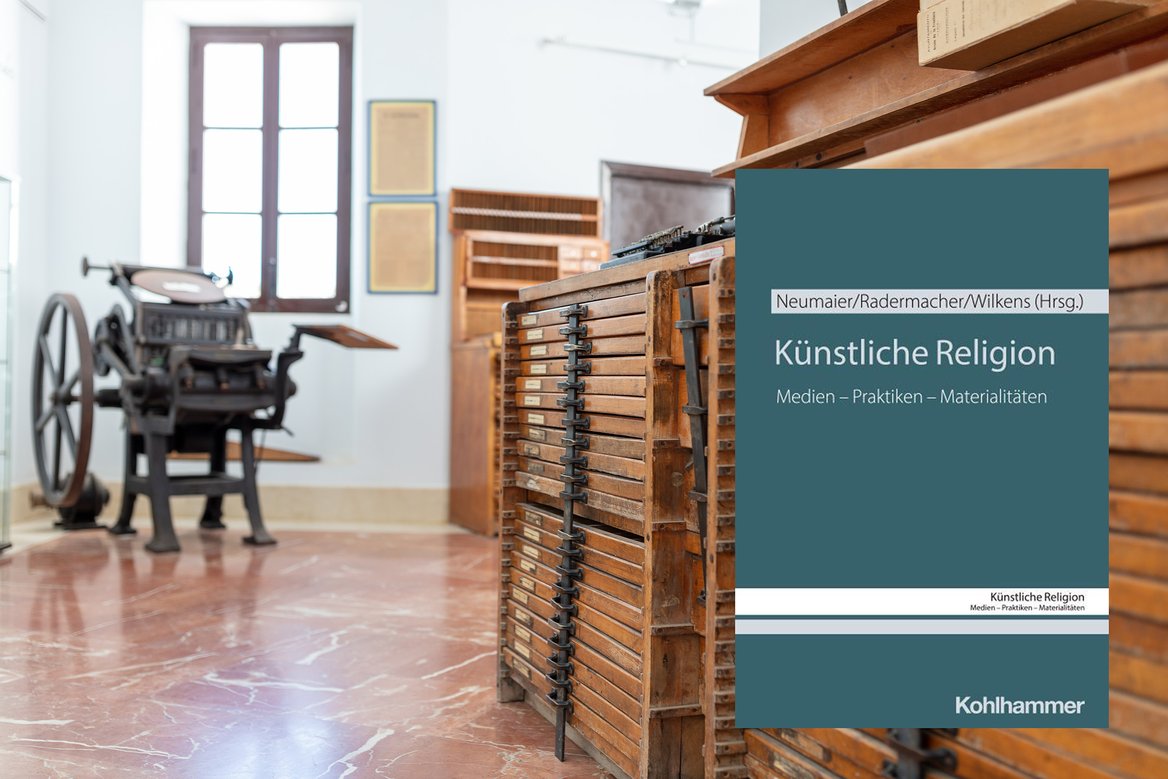
New anthology “Artificial Religion: Media – Practices – Materialities” now available
The focus is on questions of how religious experiences, identities, and myths are produced, stabilized, or transformed through media and material arrangements. The anthology spans a range from contemporary technological phenomena to historical forms of practice.
Some contributions focus on highly topical developments: Peter J. Bräunlein examines the media-technological prerequisites and semantic spaces of contact with the afterlife and communication with the deceased, while Beth Singler discusses the contours of novel conceptions of God in post-AI religiosity and analyzes “LLM-theisms” as an expression of emerging patterns of interpretation.
Other studies are devoted to contemporary fields of practice and medialities: Jakob Eißner develops a sociological perspective on mental magic as a performative staging of religious experience in the 21st century, Anne Koch discusses physical mediality in healing rituals and its situational suitability as an effective factor, and Aizhana Khasanova (CERES) presents an empirical analysis of the digital visibility of religious minorities.
In the historical section of the volume, Clara Ragnitz examines musical-religious practices in St. Joachimsthal in the 16th century and explores music as a medium and material practice during the Reformation. Yasmin Koppen approaches China's multi-local temples with an experience-based architectural analysis, and Katharina Wilkens reconstructs practices of ancestor communication and sacrificial rituals in African contexts and the diaspora from a decolonial perspective.
The volume opens up a discursive space for thinking about the media, practices, and materialities of religious phenomena together, thereby contributing to the expansion of methodological and theoretical approaches within religious studies.
Click here for the title on the publisher's website: https://shop.kohlhammer.de/kunstliche-religion-45748.html#147=9