

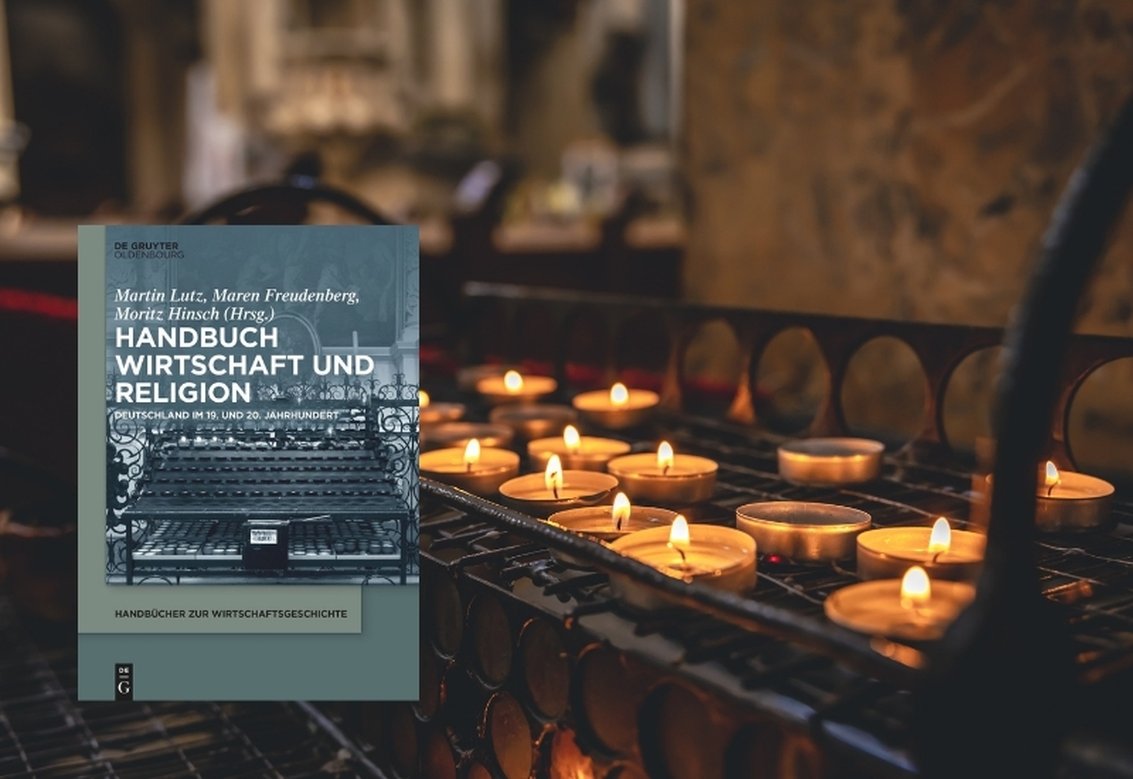
Handbook on Economy and Religion in Germany in the 19th and 20th Centuries published
With the collaboration of numerous researchers at CERES, the Handbook on Economy and Religion in Germany in the 19th and 20th Centuries, edited by Martin Lutz (Bielefeld), Maren Freudenberg (CERES/Bochum), and Moritz Hinsch (Munich). The handbook addresses a research gap that is particularly important for religious studies by shedding light on the complex relationship between economics and religion in the past and present.
The 25 chapters explain the theoretical and historical background and systematize methodological approaches to the nexus between economics and religion. They also examine the “long lines” of this relationship not only in modern times, but also in antiquity, the Middle Ages, and early modern times, tracing it through Judaism, Islam, Catholicism, Protestantism, and the spectrum of free churches. Various case studies examine religious organizations as economic actors and present further central approaches, including economics and religion as a treasure trove of metaphors and the connection between gift, sacrifice, and commodity.
The volume has been published by de Gruyter in open access and is available here:
https://www.degruyterbrill.com/document/doi/10.1515/9783110982152/html#contents